Building Trust in Elections
Key Ideas
How Trust is Measured
Trust in elections can be divided into two major ideas: whether the public perceives elections as free and fair, and whether the electoral process provides evidence that elections are conducted in accordance with the law.
Public perceptions of the conduct of elections are commonly called trust, although the term “confidence” is also sometimes used. Evidence that elections are conducted in accordance with the law can be called trustworthiness.
These two terms, trust and trustworthiness, while related, are often confused. Trust is easier to measure using survey research and is therefore usually how studies are framed when we want to know whether people think elections are free and fair.
Trust can be further broken down into different targets of investigation.
There are several ways to explore this relationship, starting with conceptualizing and measuring public “trust in elections.” The relevant terms here are “trust,” “confidence,” and “free and fair elections.” Drawing from survey research, the two ways trust has been conceptualized in election administration are:
- A belief that votes are counted accurately or as voters intended. This is the most common way survey researchers pose the question when investigating broad attitudes about the electoral process. This question can be targeted at different levels of the process–at the personal, local, state, and national levels. A variant of this question can be asked in more focused research, which is highlighted elsewhere in this playbook.
- A belief that the election process is fair and secure. The public has opinions about how elections are structured — how voters are registered, whether groups are intimidated from voting, whether an excuse is required to vote by mail, etc. Although election officials rarely have control over which processes are adopted, the public generally doesn’t know this, which is why it is important to study this topic.
What the Research Finds
The academic literature is full of research reports on the factors that influence voter trust. The White Paper on Communicating with Voters to Build Trust in the U.S. Election System provides a comprehensive summary of this literature as of 20203. Here are the four most important points to keep in mind.
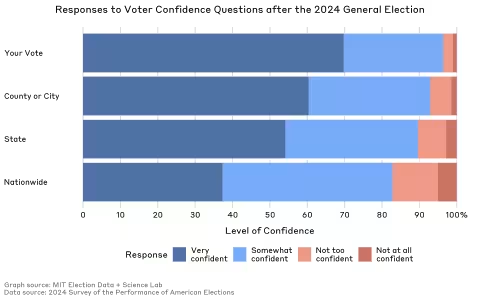
- People are more confident in election administration when it is “close” to them than when it is far away. This is illustrated in responses to a series of voter confidence questions in the 2024 Survey of the Performance of American Elections. In that nationwide study, 69% of voters stated they were very confident that their vote was counted as intended; in contrast, only 35% of all registered voters were very confident that votes were counted as intended nationwide.
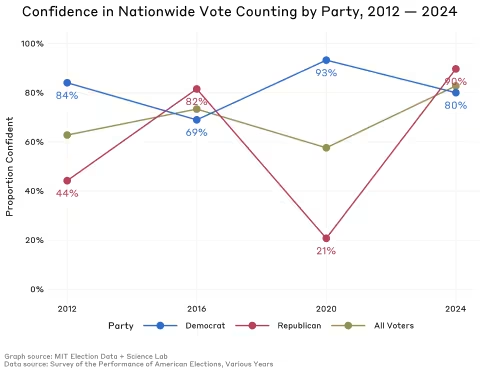
- People are more confident in election administration when the candidates they support win. This is called the “winner/loser effect.” It is easily seen in attitudes of partisan-affiliated voters following elections. It is illustrated in the percentage of Democrats and Republicans who stated they were very confident that votes nationwide were counted as intended in presidential elections from 2012 to 2024, according to the Survey of the Performance of American Elections. A more general insight from this finding is that because the public usually pays little attention to the fine points of election administration, they rely on what trusted political figures say to interpret the outcomes, positively or negatively.
- People are more confident in election administration when their personal experience is positive. People who have a bad personal experience when they vote — wait in a long line, encounter a surly election worker, don’t get a mail ballot they requested, etc. — are more likely to express distrust in elections, and they generalize this distrust broadly to the electoral process. For instance, a voter who waits in a long line to vote will be more likely to believe that votes in their locality, state, and nationwide weren’t counted properly.
- Election officials can communicate with voters to increase their trust in the process. This website features examples of research projects that have assessed strategies election officials at all levels can use to communicate with voters and increase trust. Among these strategies are facility tours, easy-to-create videos, and producing one-page summaries of post-election audit results. In addition, our partners have produced practice-tested resources and templates to help election officials communicate with the public about aspects of the election.